The UAE e-invoicing initiative is being introduced by the Ministry of Finance and the Federal Tax Authority as part of the country’s digital transformation strategy. It aims to modernise the financial ecosystem by improving tax compliance, reducing manual processes, and enabling faster, more secure business transactions. Businesses should review their accounting systems early to ensure they are ready for the upcoming compliance requirements.
Table of Contents
- What Is UAE E-Invoicing?
- Why Is the UAE Introducing Mandatory E-Invoicing?
- How UAE E-Invoicing Works
- Latest UAE E-Invoicing Deadlines You Should Know
- New UAE E-Invoicing Rules Explained
- Traditional Invoicing vs UAE E-Invoicing
- What’s New in Version 1.1 of the UAE E-Invoicing Guidelines?
- Business Risks of Delaying E-Invoicing Preparation
- How Businesses Can Prepare for UAE E-Invoicing
- Stay Ready for UAE E-Invoicing with XYRA Books
- FAQs
What Is UAE E-Invoicing?
UAE e-invoicing is a digital invoicing system that enables businesses to create, exchange, and store invoices electronically in a standardised format. Unlike traditional invoices, e-invoices contain structured data that can be automatically processed by accounting systems.
The system helps businesses automate invoice processing, reduce manual errors, improve record accuracy, and support smoother financial transactions through secure digital channels.
Why Is the UAE Introducing Mandatory E-Invoicing?
The UAE is introducing mandatory e-invoicing to modernise financial processes, strengthen VAT compliance, and improve the efficiency of tax administration.
The key objectives include:
- Improving VAT compliance and reporting accuracy
- Reducing invoice errors and fraudulent activities
- Increasing transparency in business transactions
- Automating invoice exchange
- Reducing paperwork and administrative workload
- Supporting faster tax reporting and audits
In addition to ensuring compliance, businesses can benefit from e-invoicing in the following ways:
- Faster invoice processing
- Better tax reporting accuracy
- Improved financial visibility
- Reduced administrative workload
- More accurate financial records
By replacing manual invoicing with automated digital processes, businesses can streamline operations, improve efficiency, and stay compliant with UAE tax regulations.
How UAE E-Invoicing Works
The UAE’s e-invoicing system follows the 5-Corner Model, which enables the secure exchange of electronic invoices between businesses through accredited service providers while supporting compliance with the Federal Tax Authority (FTA).
The e-invoicing process works through the following five corners:
Step 1: Supplier Creates the Invoice
The supplier creates an electronic invoice using ERP or accounting software. The invoice includes essential details such as the supplier and buyer information, invoice number, VAT details, products or services, and payment information.
Step 2: Supplier’s ERP Sends the Invoice
The supplier’s ERP or accounting software converts the invoice into the required structured electronic format and securely sends it to an accredited service provider for validation.
Step 3: Accredited Service Provider Validates the Invoice
The accredited service provider validates the invoice against the UAE’s e-invoicing requirements, performs compliance checks, and securely transmits it through the e-invoicing network.
Step 4: Buyer’s ERP Receives the Invoice
Once validated, the electronic invoice is delivered to the buyer’s ERP or accounting software, where it can be automatically processed for accounting, VAT reporting, and payment.
Step 5: Federal Tax Authority (FTA) Supports Compliance
The required invoice data is shared with the Federal Tax Authority (FTA) as part of the UAE’s e-invoicing framework. This helps improve VAT compliance, enhances transparency, and supports efficient tax reporting.
Latest UAE E-Invoicing Deadlines You Should Know
The UAE is implementing e-invoicing in phases, giving businesses time to prepare their systems and processes. Businesses with annual revenue of AED 50 million or more must appoint an Accredited Service Provider (ASP) by 30 October 2026, with mandatory implementation starting on 1 January 2027. The implementation timeline is outlined below.
| Date | Requirement | Applicable Businesses |
|---|---|---|
| 1 July 2026 | Pilot phase begins | Selected businesses |
| 30 October 2026 | Appoint Accredited Service Provider (ASP) | Businesses with annual revenue of AED 50 million or more |
| 1 January 2027 | Mandatory implementation | Businesses with annual revenue of AED 50 million or more |
| 31 March 2027 | Appoint ASP | Businesses below AED 50 million and government entities |
| 1 July 2027 | Mandatory implementation | Businesses below AED 50 million |
| 1 October 2027 | Mandatory implementation | Government entities |
Companies should start planning early by upgrading accounting systems, reviewing workflows, and ensuring ASP compatibility.
New UAE E-Invoicing Rules Explained
The UAE e-invoicing framework introduces several changes to the way businesses create and exchange invoices.
1. Structured Electronic Invoices
Invoices must be issued in a structured electronic format that accounting systems can process automatically. Paper invoices or PDF files alone may not satisfy the new requirements.
2. PEPPOL Framework
The UAE will use the PEPPOL framework for secure and standardised electronic invoice exchange, allowing different accounting systems to communicate efficiently.
3. Accredited Service Providers (ASPs)
Businesses will exchange invoices through government-approved Accredited Service Providers (ASPs), which act as intermediaries to validate invoice data and securely transmit documents between businesses through the UAE e-invoicing network.
4. Electronic Record Keeping
Businesses must securely maintain electronic records of invoices, credit notes, and related financial documents for compliance purposes.
Traditional Invoicing vs UAE E-Invoicing
Traditional invoicing relies on manual processes, while UAE e-invoicing offers a secure and automated approach. The table below highlights the key differences.
| Traditional Invoicing | UAE E-Invoicing |
|---|---|
| Paper or PDF invoices | Structured e-invoices |
| Manual processing | Automated processing |
| More errors | Higher accuracy |
| Slower approvals | Faster invoice exchange |
| Manual record keeping | Digital record storage |
What’s New in Version 1.1 of the UAE E-Invoicing Guidelines?
The updated Version 1.1 of the UAE e-invoicing guidelines provides additional clarification for businesses preparing for implementation. The key updates include:
1. Invoice Storage Requirements
Businesses remain responsible for maintaining electronic invoice records even when using third-party service providers. Organisations should ensure invoices are stored securely and can be accessed when required.
2. Advance Payment Invoices
The guidelines clarify how businesses should handle advance payments. When VAT becomes applicable on an advance payment, businesses must issue the required electronic invoice instead of waiting until the final transaction.
3. Retention Payments
The updated guidelines provide clarification for industries that commonly use retention amounts, such as construction and project-based businesses. Companies should ensure their accounting systems can correctly record and report these transactions.
These updates help businesses better understand their responsibilities and prepare their systems before mandatory implementation begins.
Business Risks of Delaying E-Invoicing Preparation
Delaying e-invoicing preparation may create operational and compliance challenges, affecting implementation timelines and daily financial operations. Businesses may face issues such as:
- Difficulty meeting compliance requirements
- Software compatibility and system integration issues
- Increased manual errors in invoicing
- Higher implementation costs due to last-minute upgrades
- Business disruptions affecting invoicing and cash flow
Preparing early allows businesses to upgrade systems, train employees, and test integrations before mandatory implementation.
How Businesses Can Prepare for UAE E-Invoicing
Early preparation helps businesses minimise compliance risks and transition smoothly to the new e-invoicing framework. Businesses can prepare by following these steps:
- Review existing invoicing processes and identify opportunities for automation.
- Upgrade to accounting software that supports digital invoicing and VAT compliance.
- Keep customer, supplier, and tax information accurate and up to date.
- Train finance teams on the new invoicing requirements.
- Test invoicing systems before mandatory implementation.
- Stay informed about updates from the UAE Ministry of Finance and the Federal Tax Authority.
Stay Ready for UAE E-Invoicing with XYRA Books
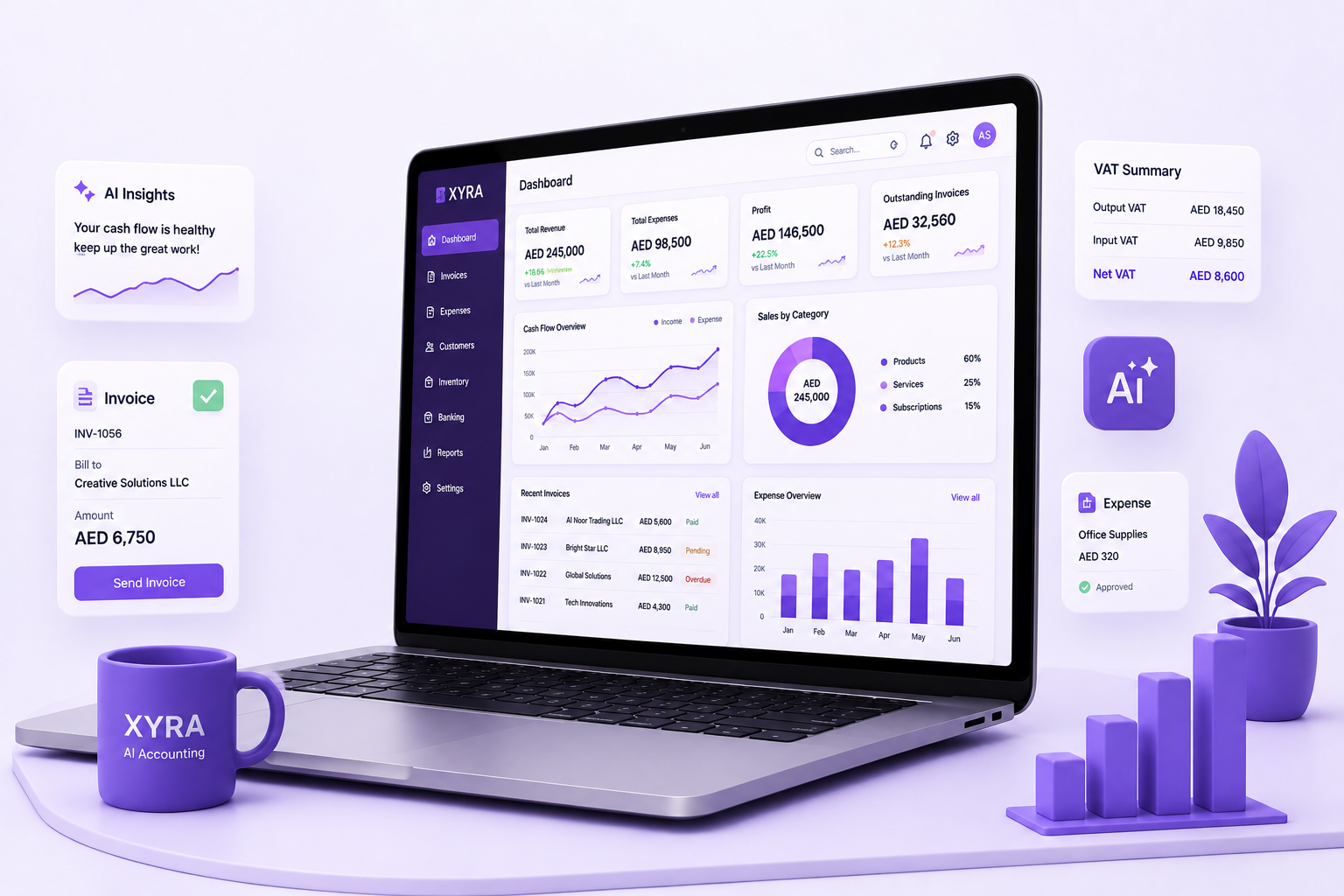
Preparing for e-invoicing requires accounting software that supports automation, VAT compliance, and digital invoicing. XYRA Books helps UAE businesses simplify financial management while preparing for the upcoming e-invoicing requirements.
Key features include:
- Automated invoicing
- VAT-ready invoice generation
- Cloud accounting
- Real-time financial reporting
- Secure document storage
Whether you’re a startup, SME, or growing enterprise, XYRA Books helps streamline accounting processes, maintain compliance, and stay ready for the UAE’s evolving e-invoicing framework.
FAQs
1. Can businesses prepare before e-invoicing becomes mandatory?
Yes. Early preparation helps ensure a smooth and compliant transition.
2. Will cloud accounting software support UAE e-invoicing?
Yes. Most modern cloud accounting software supports e-invoicing with the required integrations.
3. Are PDF invoices accepted?
No. Invoices must be issued in a structured electronic format.
4. What is an Accredited Service Provider (ASP)?
An ASP is a government-approved provider that validates and securely exchanges e-invoices.
5. Who will be affected by UAE e-invoicing?
It applies to VAT-registered businesses and will be introduced in phases.
6. When does UAE e-invoicing become mandatory?
Implementation begins from 1 January 2027 and will roll out in phases.