The UAE Ministry of Finance has just given tax groups two years of breathing room on UAE e-invoicing. Some suspect most will spend it waiting.
From 1 January 2027, invoices between members of the same VAT tax group sit outside the Electronic Invoicing System for 24 months. Everything else still goes live that day for businesses with revenue of AED 50 million or more. Their deadline to appoint an Accredited Service Provider (ASP) is 30 October 2026.
So the country's largest groups will run two invoicing tracks from day one, and every invoice has to land on the right one. Here is what changed, what didn't, and how to use the gap well.
Table of Contents
What the Ministry of Finance Decided
The changes sit in Ministerial Decision No. 197 of 2026, which amends Ministerial Decision No. 243 of 2025, the main rulebook for e-invoicing. It took effect on 1 October 2026 and does four things.
- Tax group exclusion: Business transactions between members of the same tax group count as excluded transactions for 24 months, from 1 January 2027 to 31 December 2028. A tax group means two or more persons registered with the Federal Tax Authority (FTA) as one taxable person for VAT.
- No in-country storage: E-invoices and credit notes no longer have to be stored inside the UAE. You still keep them for the period the Tax Procedures Law sets and hand them over when the FTA asks.
- No two-day failure notice: The rule that you had to report an e-invoicing system failure to the FTA within two business days is gone.
- More time to issue: The deadline for issuing an e-invoice or credit note moves from 14 calendar days to 14 business days.
What the decision leaves alone matters as much. Invoices a group member sends to anyone outside the group still go through the system from day one. The relief covers one lane, not the whole road.
The Deadlines That Did Not Move
None of the core dates changed. Businesses with revenue of AED 50 million or more appoint an ASP by 30 October 2026 and go live on 1 January 2027. That appointment date was already pushed once, from 31 July, by Ministerial Decision No. 66 of 2026, and the FTA confirmed it again on 29 September.
Everyone else in scope appoints an ASP by 31 March 2027 and goes live on 1 July 2027. Government entities follow on 1 October 2027.
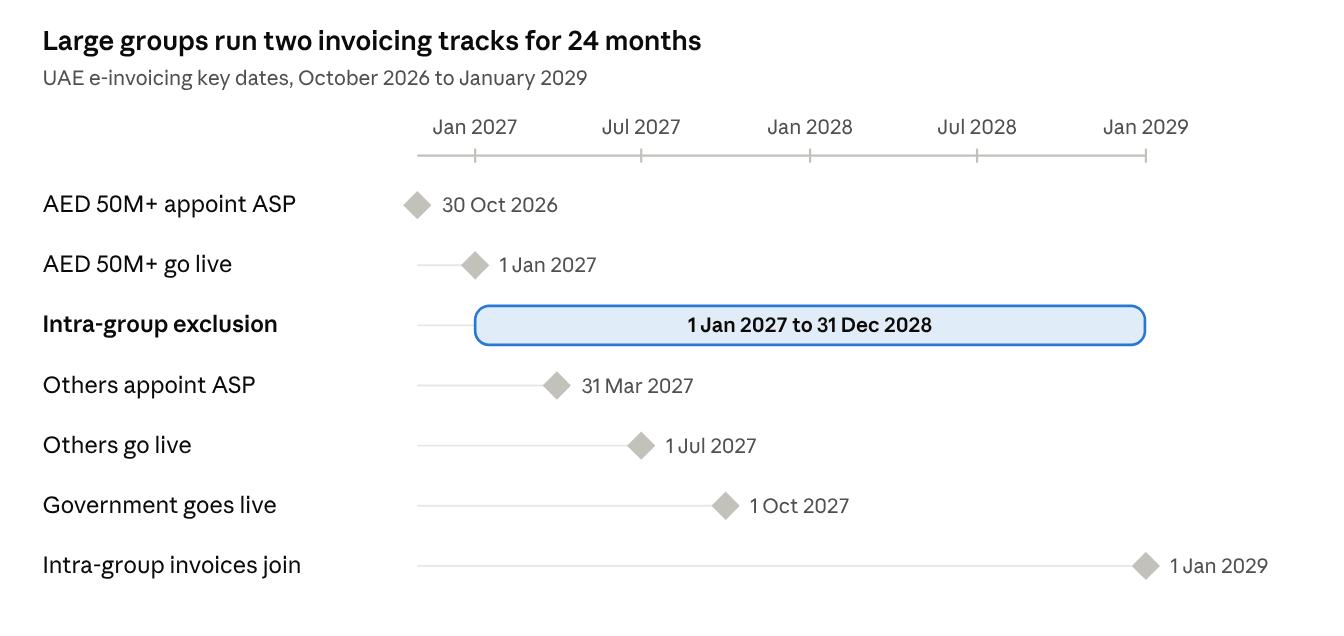
UAE e-invoicing timeline · 6 dates, 1 exclusion window
Groups above AED 50 million run both tracks from their first day live.
Separately, Ministerial Decision No. 168 of 2026 scrapped the pre-approval stage for providers. Only fully accredited ASPs count now, so check your provider on the Ministry's register before you sign.
The FTA Rules Running Alongside
Two FTA rules make the tax group question sharper.
FTA Directive No. 2 of 2026, in force since 1 August 2026, covers members that leave a VAT group but stay registered. If a credit note, discount, rebate or bad debt relief later touches a supply made while they were inside the group, the former member reports the VAT adjustment in its own return, not the group's. It must keep records linking the adjustment back to the original group return. Members also stay jointly liable for the group period.
FTA Decision No. 13 of 2026, in force since 1 October 2026, ties input VAT recovery to supplier due diligence. You verify a supplier on first contact and again if 12 months pass without a check. Suppliers billing over AED 375,000 a year need extra checks, including a bank confirmation. Supplies under AED 10,000 can skip the checks, unless that supplier crosses AED 100,000 in the year.
Put the three rules together and it comes down to one question. Do your books know, transaction by transaction, who is inside the group, who isn't, and when that changed?
The Numbers That Matter
These are the figures a finance team should keep in front of them.
| Item | Figure |
|---|---|
| Phase 1 revenue threshold | AED 50 million or more |
| Intra-group exclusion | 1 Jan 2027 to 31 Dec 2028 |
| Mandatory fields on a tax invoice (PINT AE) | 51 |
| Deadline to issue an e-invoice | 14 business days |
| Late ASP appointment or failure to implement | AED 5,000 a month |
| Invoice or credit note not issued through the system | AED 100 each, capped at AED 5,000 a month per type |
| Accredited ASPs on the Ministry's register | 65 (as of 14 October 2026) |
And a few you should work out for your own business:
- Worst-case exposure: Under Cabinet Decision No. 106 of 2025, a business that misses its ASP appointment and keeps sending PDF invoices could face AED 10,000 a month: AED 5,000 for not implementing, plus the AED 5,000 cap on invoices. That is AED 120,000 a year before credit notes.
- Your real relief window: A Phase 2 group that goes live on 1 July 2027 gets 18 months of intra-group relief, not 24, because the clock started in January.
- Your two-track split: Divide last year's invoices into intra-group and external. The intra-group share is the volume that joins the system in January 2029.
- Master data readiness: What share of your counterparties has a verified TRN, a group flag and an e-invoicing address? Anything below 100% is a routing error waiting to happen.
Where AI-Driven Companies Earn Their Keep
Running two tracks by hand means someone checks each invoice against a group list that may be out of date. This is where AI accounting software and AI-driven compliance platforms in the UAE prove useful, mostly in unglamorous ways.
- Tagging counterparties against group membership, TRN and licence data, and keeping the tags current.
- Routing invoices so intra-group ones take the excluded track and the rest go to the ASP in PINT AE format over the Peppol network.
- Catching gaps early by checking the 51 mandatory fields before an invoice is rejected on day 13 of 14.
- Linking adjustments so a credit note issued after a member leaves traces back to the original group return.
- Tracking supplier checks to show who is due for re-verification and who has crossed AED 375,000.
The judgment calls stay with people: whether a restructuring changes membership, how a mixed supply is treated, when to make a voluntary disclosure. AI clears the routine so the tax team has time for those.
What This Means for UAE SMEs
SMEs make up about 95% of the more than 1.4 million companies registered in the UAE, and most fall into Phase 2. The next two years give them three things.
- A free rehearsal: Large businesses go live six months earlier, so their problems with providers, data and rejected invoices will be well known by mid-2027.
- A nudge from customers: If you sell to a large company, expect it to ask for structured e-invoices soon after January 2027, whatever your own deadline. Being ready early helps you win and keep that business.
- The same relief: Family businesses often run several trading companies under one UAE VAT group. The exclusion covers them until 31 December 2028.
Some basics hold. E-invoicing compliance applies to B2B and B2G sales whether or not you are VAT registered, while consumer-only businesses stay outside scope for now. With the local storage rule gone, cloud accounting tools hosted abroad are also simpler to use.
How to Use the 24 Months
- Confirm your ASP is fully accredited and sign before your deadline.
- Keep one list of every group entity, with its TRN and the dates it joined or left.
- Tag every customer and supplier as inside or outside the group.
- Set your ERP to treat intra-group invoices as excluded until 31 December 2028 and send everything else through the ASP.
- Write down who updates the list when a member joins or leaves, and how later adjustments get reported.
- Test intra-group invoices on the system during 2028, so January 2029 is a switch, not a project.
Use these 24 months to fix the data, and January 2029 becomes a non-event. Wait, and you will be doing in a rush in late 2028 what you could have done calmly now.