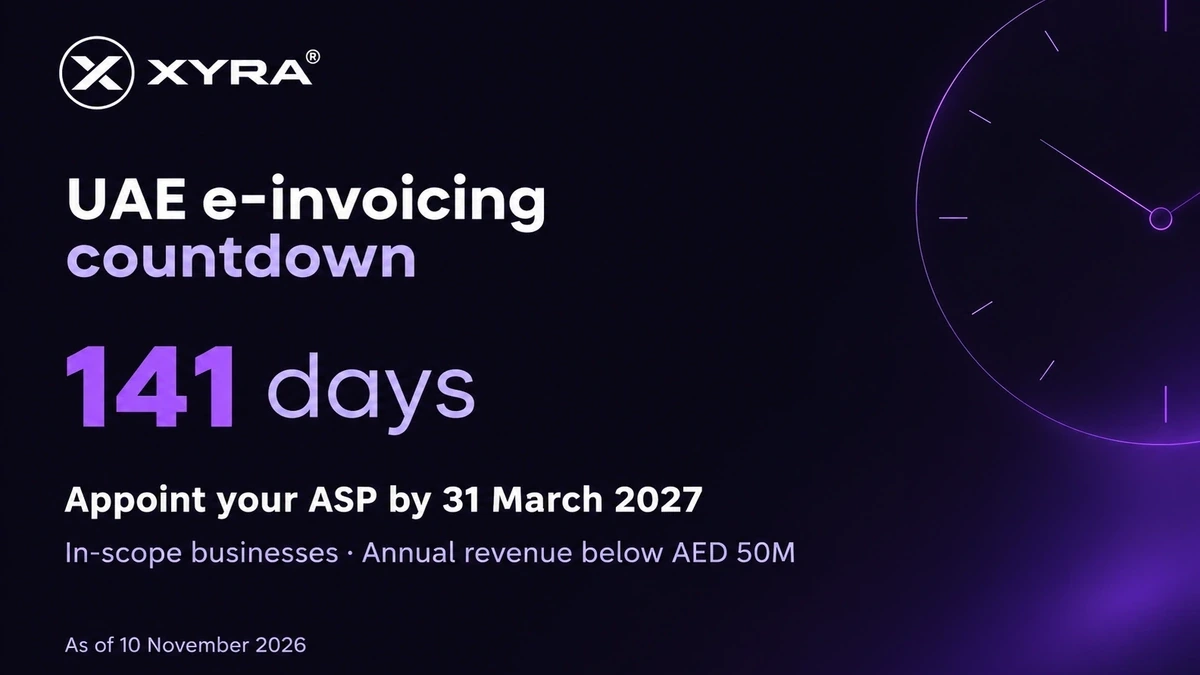
If your business turnover is less than AED 50 million a year, 31 March 2027 is the date to plan around. That is the last day to appoint an Accredited Service Provider (ASP) under the UAE e-invoicing mandate. Three months later, on 1 July 2027, every B2B and B2G invoice you raise has to move as structured data over the Peppol network. A PDF attached to an email will no longer count as a valid tax invoice.
Five months sounds like a comfortable runway. It isn't, and the businesses that went first are the proof. Companies above the AED 50 million mark had their ASP deadline pushed from 31 July to 30 October 2026, but their go-live date of 1 January 2027 never moved. The extra time went into the slow, unglamorous work: cleaning customer records, fixing tax registration numbers, mapping invoice templates to the new data model and testing everything end to end.
This guide covers what the mandate requires, who it hits and when, what it costs to get wrong, and how SMEs can use AI-powered accounting software to get compliant without hiring a project team.
Table of Contents
What the UAE E-Invoicing Mandate Actually Means
The rules sit in Ministerial Decisions No. 243 and 244 of 2025, which set the scope and the timeline, and Cabinet Decision No. 173 of 2026, which sets the penalties. Under them, an e-invoice is a structured XML file that machines can read and validate. A PDF, a Word file, a scan or a photo of an invoice does not qualify, however official it looks.
The Ministry of Finance chose a decentralised model it calls DCTCE (Decentralised Continuous Transaction Control and Exchange). It runs on the Peppol network and works across five corners:
- You, the supplier, send invoice data to your ASP.
- Your ASP validates it, formats it as PINT AE, delivers it to your buyer's ASP and reports the tax data to the Federal Tax Authority (FTA).
- Your buyer's ASP validates the invoice and returns a status message.
- Your buyer receives the invoice in their own system.
- The FTA receives the tax data and confirms it.
Two practical consequences follow. You cannot connect to the FTA directly, so every in-scope business needs exactly one MoF-accredited ASP for both sending and receiving. And unlike Saudi Arabia's clearance model, the FTA does not approve each invoice before your customer sees it. Invoices move fast, but the responsibility for clean data sits with you.
PINT AE is the UAE's version of Peppol's international invoice standard. Your Peppol ID will be 0235 followed by your 10-digit Tax Identification Number, which is the first 10 digits of your TRN.
Who Has to Comply, and by When
The rollout is phased by revenue, measured as gross income in your most recent accounting period based on your financial statements.
| Who | Appoint an ASP By | E-Invoicing Mandatory From |
|---|---|---|
| Pilot group and voluntary adopters | Not applicable | 1 July 2026 |
| Revenue of AED 50 million or more | 30 October 2026 (extended from 31 July) | 1 January 2027 |
| Revenue under AED 50 million | 31 March 2027 | 1 July 2027 |
| Government entities | 31 March 2027 | 1 October 2027 |
Three points trip people up. First, the mandate applies to any person doing business in the UAE, whether they are VAT registered or not. Free zone companies are in, and so are foreign businesses that make business transactions in the UAE. Second, any business can go live voluntarily before its date, and penalties only start from your mandatory date, which makes early adoption a low-risk dress rehearsal.
Third, and most important for SMEs: your large customers and suppliers go live on 1 January 2027. Their e-invoices will start arriving, and their procurement teams may well start asking for your Peppol ID, six months before your own deadline.
What Changes on the Invoice Itself
The MoF has published a list of 51 mandatory fields for a standard tax invoice, built on the PINT AE data dictionary. Many are familiar, like invoice number, date, TRNs and VAT amounts. Others go beyond what most UAE VAT invoices carry today, which is why data mapping, not software, is usually the longest part of the project.
What Is in Scope
- Every B2B and B2G transaction: Issuers must send an e-invoice, and recipients must receive and process e-invoices through the system.
- Electronic credit notes: Whenever a sale is cancelled, the price is reduced, money is refunded or an error needs correcting.
- Exports: Tax invoices for exports must be e-invoices too. If your overseas buyer has no Peppol ID, a predefined endpoint is used.
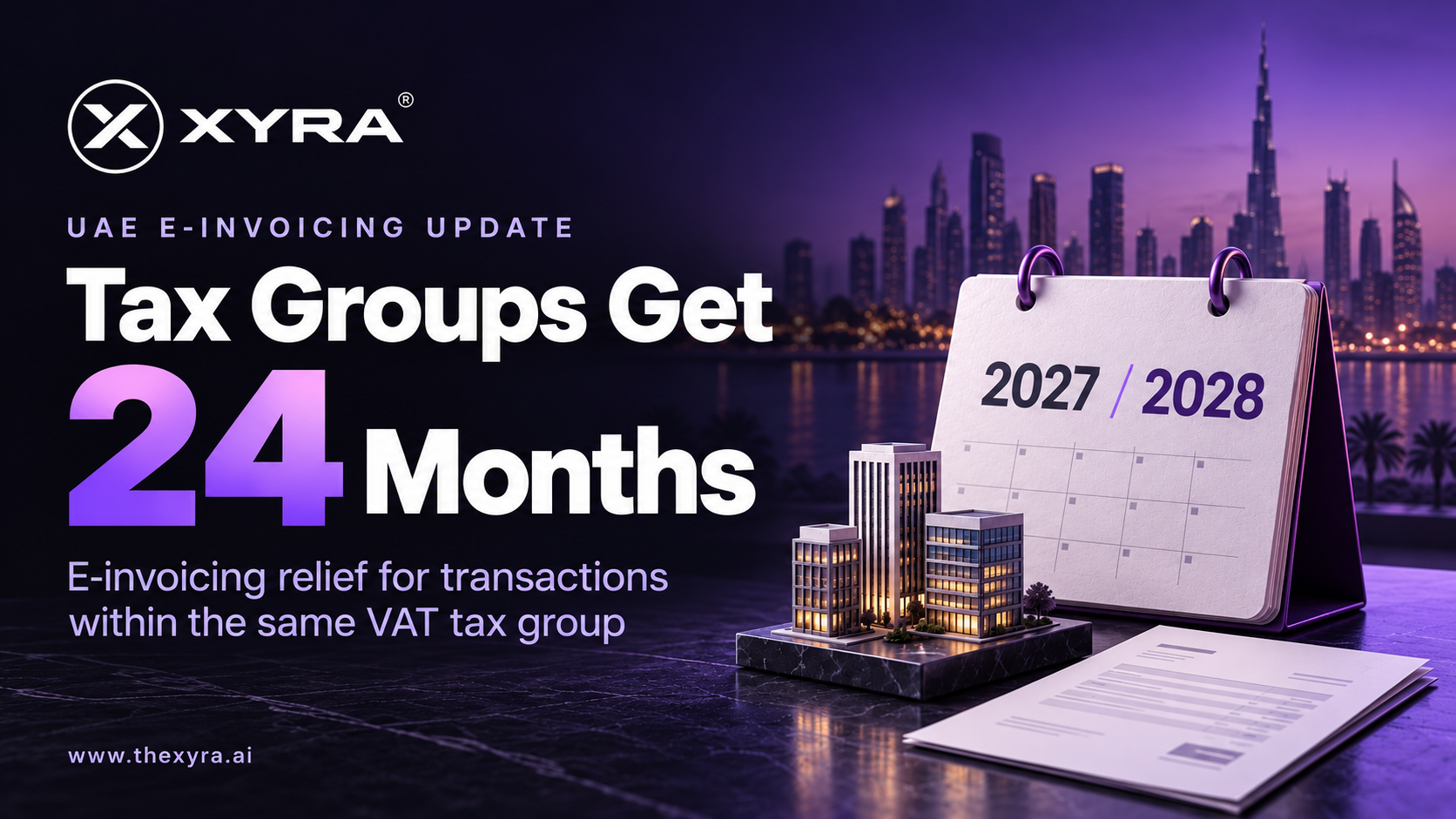
- VAT groups: Transactions between group members are in scope, with a 24-month grace period for intra-group invoices from 1 January 2027.
What Is Excluded, for Now
- B2C sales to individuals not acting in business. Businesses that only sell to consumers are out until the Minister sets a date.
- International airline passenger transport issued with an e-ticket, and airline cargo with an air waybill for the first 24 months.
- VAT-exempt or zero-rated financial services.
- Government entities acting in a sovereign capacity that don't compete with the private sector.
One more obligation is easy to miss. If your FTA-registered details change, you have five business days from the FTA's confirmation to tell your ASP.
What Getting It Wrong Costs
Cabinet Decision No. 173 of 2026 (which replaced Cabinet Decision No. 106 of 2025) attaches a fine to each failure, and the fines stack.
| Violation | Penalty |
|---|---|
| Not implementing the system or not appointing an ASP on time | AED 5,000 for each month or part of a month, capped at AED 50,000 in any 12 months |
| Not issuing and sending an e-invoice | AED 100 per invoice, capped at AED 5,000 a month |
| Not issuing and sending an e-credit note | AED 100 per credit note, capped at AED 5,000 a month |
| Not telling your ASP about changes to your registered data | AED 250 per day of delay, capped at AED 5,000 a month |
Missing the ASP deadline alone can cost up to AED 50,000 a year. Add the invoice penalty and a business that simply ignores the mandate is looking at AED 10,000 a month before anything else goes wrong.
The fines are only part of the bill. Once your biggest customers run on Peppol, an invoice that doesn't fit their process tends to sit in a queue, and your cash flow pays for the delay.
A Month-by-Month Plan for the Next 155 Days
The 31 March deadline is for appointing an ASP, but you need the ASP well before then to test anything. Work backwards and the plan looks like this.
- November, confirm your phase and map your invoices: Check revenue in your latest financial statements against AED 50 million. List every invoice flow you have: local B2B, government, exports, intra-group, credit notes, and anything excluded.
- December, clean your master data: Verify your own TRN and registered details. Collect TRNs and correct legal names for every business customer. Fix duplicate customers, missing addresses and inconsistent VAT codes. Get ready to receive e-invoices from large suppliers going live on 1 January.
- January, choose and appoint your ASP: Compare providers on ERP integration, how clearly they explain validation errors, how they handle credit notes and special cases, archiving, local support and cost. Onboard through the FTA's EmaraTax portal and get your Peppol ID.
- February, map and test: Match your invoice data to the PINT AE fields, then test real scenarios end to end: a standard invoice, a credit note, an export, a reverse charge case.
- March, sign off: Train the people who raise and approve invoices. Write down what happens if the system fails or your ASP goes down, so invoices keep moving. Make sure the ASP appointment is complete well before 31 March.
- April to June, go live early: Use voluntary adoption to run the new process before penalties apply, so 1 July is a normal working day rather than a launch.
Where AI-Powered Accounting Software Earns Its Keep
An ASP moves your invoices. It doesn't fix them. If a TRN is wrong or a VAT code is missing, the invoice fails validation and comes back to you. That is why your accounting software matters as much as your provider.
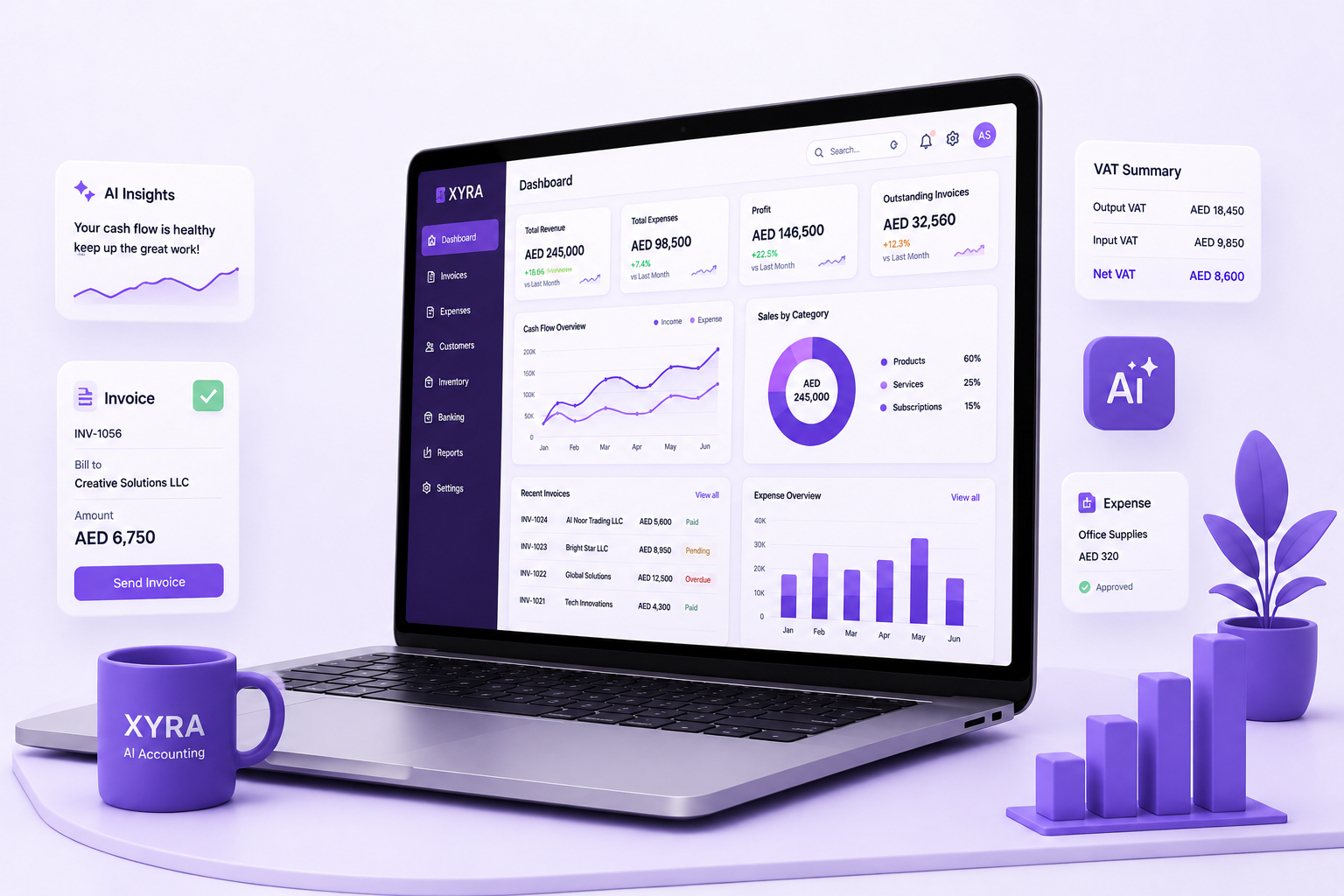
XYRA Books, the AI-powered accounting software built in Dubai for UAE businesses, treats e-invoicing as part of everyday invoicing rather than a bolt-on:
- PINT AE on every invoice, with VAT treatment, place of supply and free zone fields handled in the background.
- Peppol through Accredited Service Providers, so there is no separate portal to manage.
- TRN validation at the point of entry, so a bad registration number is caught before it causes a rejection.
- AI on the incoming side too. XYRA reads supplier bills from PDFs or phone photos, codes each line and reconciles your bank automatically.
- Ask XYRA, for plain-language answers like who hasn't paid you or what your VAT position looks like.
Invoicing, VAT returns, corporate tax filing, payroll and expenses share one ledger, so the data your e-invoices depend on stays consistent. Data is hosted in the UAE, and migration from Zoho, QuickBooks or Xero is free.
For accounting firms, every SME client faces the same 31 March deadline. XYRA's partner program lets firms manage clients on one platform and earn commission on the businesses they bring in.
The Clock Doesn't Pause
Five months is enough time to do this properly. It is not enough time to start in March. The businesses that have a calm July will be the ones that clean their data this winter, appoint a provider early and use the spring to practise.
Start your e-invoicing readiness plan with XYRA today, or book a demo and watch a compliant PINT AE invoice go from XYRA Books to the Peppol network.
FAQs
1. Is e-invoicing mandatory for small businesses in the UAE?
Yes, if you sell to other businesses or to government. Businesses with revenue under AED 50 million must appoint an Accredited Service Provider by 31 March 2027, and e-invoicing becomes mandatory for them from 1 July 2027. Being small doesn't take you out of scope. Only business-to-consumer sales are outside it for now.
2. Does UAE e-invoicing apply if my business is not VAT registered?
Yes. What triggers the requirement is a business transaction, not VAT registration. Businesses that aren't VAT registered need a Tax Identification Number (TIN) from the FTA to join the system, and they must issue and send their e-invoices within 14 days of the transaction date.
3. Can I still send PDF invoices once e-invoicing starts?
You can still email a PDF copy for your customer's convenience, but it won't replace the structured e-invoice for in-scope transactions. The valid tax invoice is the XML file that travels through your ASP, so keep the XML along with its acknowledgements and status messages as your record, not just the PDF.
4. Does the buyer also need an Accredited Service Provider?
Yes. Buyers need an ASP too, because they have to receive e-invoices through the network. Most businesses use a single provider for both sending and receiving, which keeps reconciliation, reporting and support simpler.
5. How long do I need to keep e-invoices in the UAE?
Keep them for at least five years from the end of the relevant tax period, and seven years for corporate tax records, with up to 15 years for certain real estate records. Your ASP can store them for you, and the old rule to store data inside the UAE has been replaced by a duty to keep the data and produce it on request. The legal responsibility stays with you even if storage is outsourced.