For years, the UAE was known as a place where businesses paid no tax on their profits. That changed on 1 June 2023, when federal corporate tax came into force. Today, almost every business that earns money in the country needs to know where it stands: whether it must register, how much it owes, and when the return is due.
This guide covers the rules that matter most for owners, finance heads and accountants. It explains the rates, the registration and filing steps, the reliefs and exemptions, and the records you need to keep. It also looks at how the right accounting setup makes Corporate Tax compliance in the UAE far less stressful. Below is a plain guide to Corporate Tax UAE (rates, registration and filing), the main Corporate Tax Rules UAE (exemptions and reliefs) and Corporate Tax Compliance UAE (records and penalties).
Table of Contents
- Understanding the UAE Corporate Tax System
- Which Businesses Are Subject to Corporate Tax in the UAE?
- UAE Corporate Tax Rates and Taxable Profit Explained
- Corporate Tax Registration Rules for UAE Businesses
- How to Meet UAE Corporate Tax Filing Requirements
- Corporate Tax Exemptions and Small Business Relief in the UAE
- Financial Records Required for UAE Corporate Tax Compliance
- How Accounting Software Supports Corporate Tax Management
- Corporate Tax and VAT: Key Differences for UAE Businesses
- Common Corporate Tax Compliance Challenges for Small Businesses
- FAQs
Understanding the UAE Corporate Tax System
Corporate Tax in the UAE is a direct tax on the net profit of a business. It was introduced through Federal Decree-Law No. 47 of 2022 and is administered by the Federal Tax Authority (FTA). It applies to financial years starting on or after 1 June 2023, so a company with a calendar year (January to December) first came into scope for the year starting 1 January 2024.
The tax is charged on taxable income, which is your accounting profit adjusted for items the law treats differently (for example, certain non-deductible expenses and exempt income). It is not charged on revenue. A business that makes a loss generally pays no corporate tax for that period.
All returns and payments go through the FTA's EmaraTax portal. Registration and filing for Corporate Tax in UAE both happen online.
Which Businesses Are Subject to Corporate Tax in the UAE?
The short answer is that most businesses are. The rules cover:
- UAE companies and other legal entities, including mainland and free zone companies
- Foreign companies that are effectively managed and controlled from the UAE
- Foreign businesses with a permanent establishment in the UAE
- Individuals (such as freelancers and sole proprietors) who run a business or commercial activity in the UAE and earn more than AED 1 million a year from it
Some persons are exempt, subject to conditions. These include government entities, certain government-controlled businesses, qualifying public benefit entities, pension and social security funds, and qualifying investment funds. Some exempt persons still have to register with the FTA and file an annual declaration, so exemption does not always mean zero paperwork.
Salary, personal investment income and income from owning personal real estate are not subject to Corporate Tax.
UAE Corporate Tax Rates and Taxable Profit Explained
The UAE Corporate Tax rates are simple:
- 0% on taxable income up to AED 375,000
- 9% on taxable income above AED 375,000
- 0% on the qualifying income of a Qualifying Free Zone Person (more on this below)
The 9% applies only to the slice of taxable income above the threshold, not to the full profit. Taxable income here means your net profit after all Corporate Tax adjustments. Only the amount left above the AED 375,000 exemption threshold is charged at 9%.
| Taxable income | Tax at 0% band | Tax at 9% band | Corporate tax due |
|---|---|---|---|
| AED 300,000 | AED 0 | AED 0 | AED 0 |
| AED 500,000 | AED 0 | AED 11,250 | AED 11,250 |
| AED 1,000,000 | AED 0 | AED 56,250 | AED 56,250 |
Large multinational groups that fall under the OECD Pillar Two rules may face a different top-up rate, but that does not apply to the typical SME. For most SMEs, UAE Corporate Tax Rates come down to the 0% and 9% bands above.
Corporate Tax Registration Rules for UAE Businesses
Registration is separate from VAT registration, and it applies even if you expect to pay nothing. Free zone companies and businesses that qualify for the 0% band must still register and file. The AED 1 million turnover threshold applies only to individuals (natural persons): they must register once their business turnover in a calendar year goes above AED 1 million. Companies and other legal entities must register whatever their turnover.
The registration deadline depends on the type of taxpayer:
- Companies incorporated on or after 1 March 2024: within three months of incorporation
- Foreign companies managed and controlled from the UAE: within three months of the end of the financial year in which they become tax resident
- Earlier-established businesses: deadlines were staggered by licence month and have largely passed
Registering gives you a Tax Registration Number (TRN) through EmaraTax. Missing the deadline triggers an administrative penalty of AED 10,000. The FTA has offered a one-time waiver to some late registrants who filed their first return within seven months of the end of their first tax period, so if you registered late, check whether it applies to you.
How to Meet UAE Corporate Tax Filing Requirements
For Corporate Tax filing in the UAE, the rule is one return per tax period, filed and paid within nine months of the period ending. The return and the payment share the same date, and there is no extension process.
A company with a 31 December year end must file and pay by 30 September of the following year. The deadline for the 2025 financial year was 30 September 2026, and the next one, for the 2026 financial year, falls on 30 September 2027.
| Financial year end | Filing and payment deadline |
|---|---|
| 31 March 2026 | 31 December 2026 |
| 30 June 2026 | 31 March 2027 |
| 31 December 2026 | 30 September 2027 |
The penalties for getting this wrong add up quickly:
- Late filing: AED 500 per month for the first 12 months, then AED 1,000 per month
- Late payment: 14% per year on the unpaid amount
- Late registration: AED 10,000
Filing on time but paying late still counts as non-compliance, so treat the return and the payment as one task. Keep this in mind for Corporate Tax Filing UAE every year.
Corporate Tax Exemptions and Small Business Relief in the UAE
Two reliefs matter most for growing businesses.
Small Business Relief. A UAE resident business with revenue of AED 3 million or less can elect to be treated as having no taxable income for a tax period, which brings the tax bill to zero. The Ministry of Finance has extended this relief to tax periods ending on or before 31 December 2029 (Ministerial Decision No. 131 of 2026), and the AED 3 million threshold has not changed.
A few points trip people up:
- The test is based on revenue, not profit. A business with AED 3.2 million in revenue is over the line even if it made a loss.
- Revenue must stay at or below AED 3 million in the current period and in every earlier period starting on or after 1 June 2023. Once you go over, you lose the relief for good.
- It is not automatic. You must elect it in the Corporate Tax return each period.
- Qualifying Free Zone Persons cannot use it, and using it limits some options, such as carrying forward tax losses.
Qualifying Free Zone Person (QFZP) status. A free zone licence does not automatically mean 0% tax. A free zone company gets the 0% rate on qualifying income only if it meets all the conditions, including having adequate substance in the free zone, earning qualifying income, staying within the de minimis limits on non-qualifying income, and following transfer pricing rules. Income that does not qualify is taxed at 9%. A company that fails the conditions is taxed at the standard rates for at least five tax years.
Dividends received from other UAE resident companies are generally exempt from Corporate Tax as well.
Financial Records Required for UAE Corporate Tax Compliance
The FTA expects you to keep proper accounting records and the documents that support them. In practice, that means:
- General ledger, trial balance and financial statements
- Sales and purchase invoices, credit notes and receipts
- Bank statements and reconciliations
- Contracts, payroll records and fixed asset registers
- Tax computations and working papers
- Transfer pricing documentation, where it applies
All of it must be kept for at least seven years after the end of the tax period it relates to.
Audited financial statements are required for Qualifying Free Zone Persons and for any business with revenue above AED 50 million in the tax period. Other taxpayers prepare financial statements under IFRS or IFRS for SMEs, and smaller businesses relying on Small Business Relief can use simpler reporting.
A missing invoice or an unreconciled bank account is a small problem in January and a big one when the FTA asks for evidence years later.
How Accounting Software Supports Corporate Tax Management
Spreadsheets and shoeboxes of receipts can get a small business through its first year. They rarely survive a tax return. Good accounting software for UAE businesses helps in four practical ways:
- Clean books all year. Transactions are coded as they happen, so the profit figure you start from at year end is reliable.
- Easier tax adjustments. You can separate exempt income, non-deductible costs and related-party transactions without rebuilding the ledger.
- Audit-ready records. Invoices, receipts and bank data sit in one place, which makes the seven-year record rule far easier to meet.
- One system for several taxes. The same data supports Corporate Tax, VAT and, from 2027, e-invoicing.
That last point deserves attention. Businesses covered by the UAE e-invoicing rollout will need systems that can issue and exchange structured invoices through an Accredited Service Provider. Picking software that already handles this saves you a second migration later. (If you want the full timeline, see our guide to UAE e-invoicing deadlines.) Planning early for E-Invoicing UAE also keeps your Corporate Tax records tidy.
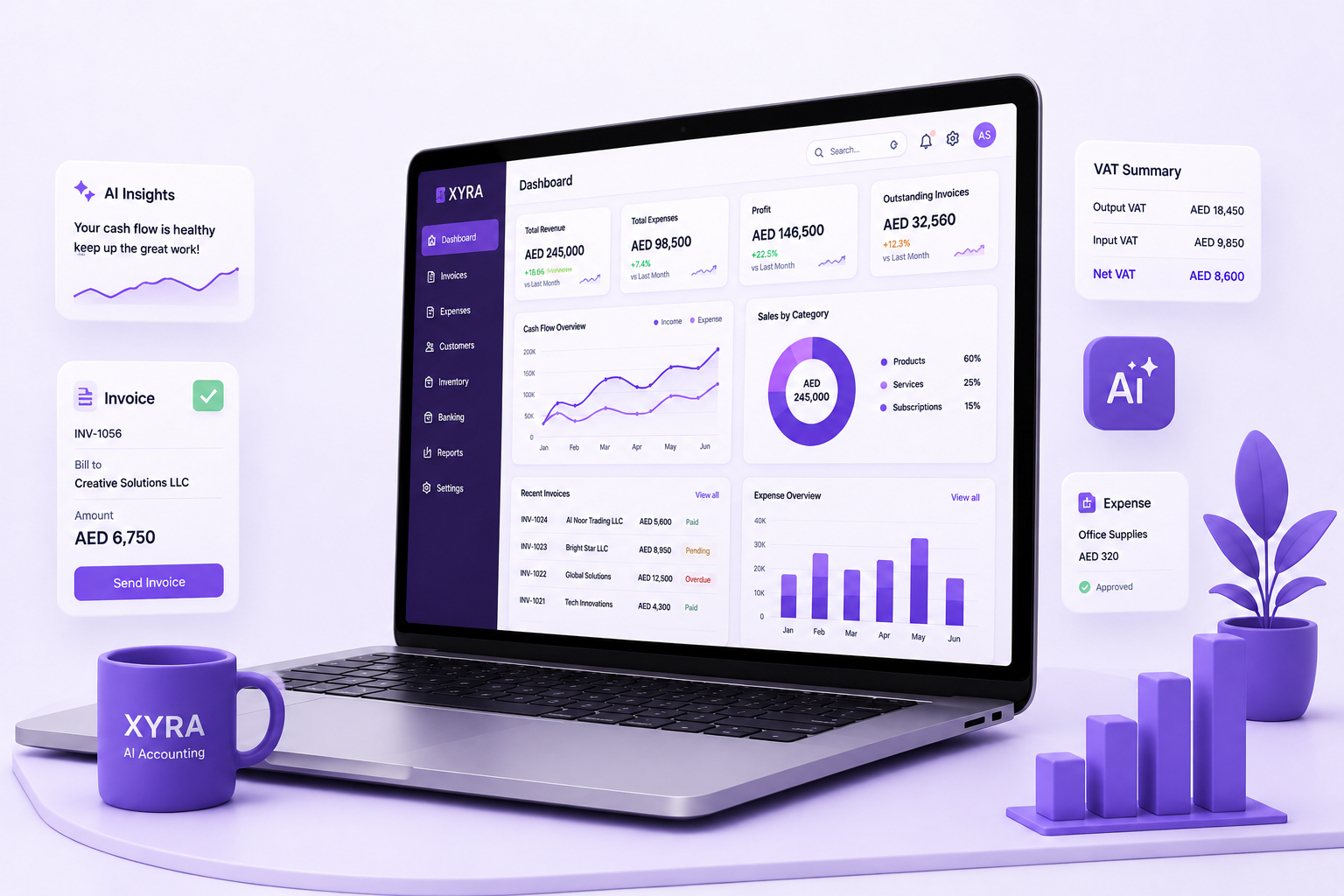
XYRA is built for this kind of work: AI-assisted bookkeeping and finance automation for UAE businesses and the accounting firms that serve them, so the numbers behind your Corporate Tax return are ready before the deadline, not after it. If you are comparing Accounting Software UAE businesses can choose from, look for one that covers all of this in one place.
Corporate Tax and VAT: Key Differences for UAE Businesses
Many owners assume that being registered for VAT covers Corporate Tax too. It does not. They are two separate taxes with separate registrations, returns and deadlines. Keeping your records for VAT in UAE and Corporate Tax consistent saves trouble later.
| Corporate Tax | VAT | |
|---|---|---|
| What is taxed | Net profit | Supply of goods and services |
| Rate | 0% up to AED 375,000, 9% above | 5% standard rate |
| Who bears it | The business | The end consumer (the business collects and passes it on) |
| Return frequency | Once a year | Usually every quarter |
| Registration | Mandatory for all companies and legal entities, even at zero tax. Individuals register only above AED 1 million of annual turnover | Mandatory above AED 375,000 of taxable supplies, voluntary from AED 187,500 |
| Filing deadline | 9 months after year end | 28 days after the tax period ends |
The two do connect. The revenue and expense records that support your VAT returns also feed your Corporate Tax computation, so inconsistencies between them are a common reason for FTA queries.
Common Corporate Tax Compliance Challenges for Small Businesses
The mistakes we see most often are quite ordinary:
- Assuming a free zone licence means no tax. Without QFZP status, the 9% rate can apply.
- Confusing the two AED thresholds. The AED 375,000 figure is the 0% band on profit. The AED 3 million figure is the Small Business Relief limit on revenue. The AED 1 million figure is the registration threshold for individuals (natural persons) only. Companies and other legal entities must register whatever their turnover.
- Forgetting to elect Small Business Relief. It has to be claimed in the return, every period.
- Late or missing registration. The AED 10,000 penalty is avoidable.
- Weak records. Mixed personal and business spending, missing invoices and unreconciled accounts make the tax computation slow and risky.
- Treating the return as a year-end job. Leaving everything until month eight leaves no time to fix what the numbers show.
The fix for most of these is the same: keep the books current through the year, and check your position every quarter.
FAQs
1. What is the corporate tax rate in the UAE?
It is 0% on taxable income up to AED 375,000 and 9% on the portion above that. Qualifying Free Zone Persons pay 0% on qualifying income, and 9% on income that does not qualify.
2. Do I have to register for Corporate Tax if my profit is below AED 375,000?
Yes, in most cases. The 0% band is a tax rate, not an exemption from registering. Free zone companies and businesses planning to claim Small Business Relief also need to register and file.
3. When is the Corporate Tax return due?
Nine months after the end of your financial year. For a 31 December year end, that is 30 September of the next year. Any tax due must be paid by the same date.
4. What is the penalty for filing late?
AED 500 per month for the first 12 months, then AED 1,000 per month. Late payment also attracts interest of 14% per year, and missing registration carries an AED 10,000 penalty.
5. Who can claim Small Business Relief?
UAE resident businesses with revenue of AED 3 million or less in the current and all earlier tax periods (from 1 June 2023), provided they are not Qualifying Free Zone Persons and have not split their business to stay under the limit. The relief runs for tax periods ending on or before 31 December 2029, and it must be elected in the return.
6. How long do I need to keep Corporate Tax records?
At least seven years from the end of the tax period they relate to.
7. Is Corporate Tax the same as VAT?
No. VAT is a 5% consumption tax on supplies of goods and services. Corporate Tax is a tax on business profit. Each has its own registration, return and deadline.